
Why we built AgentConnect
Everyone on our team was building the same agent glue. So we built it once.

It started with writing code
Like most teams, we started simple: everyone ran Claude Code or Codex in their own terminal and used it to write code.
The agents kept getting better, so we started giving them other jobs. A production error? Let an agent do the first pass of analysis. An upstream dependency shipped a new release? Let an agent upgrade our binaries. Daily health checks. First-pass review on incoming PRs. A customer question in the chat? Let an agent draft the answer.
Somewhere along the way, our agents crossed the line from “coding tool” to something much closer to a working member of the team.
An agent is not “an API call to a model.” The model may run at a provider — the agent itself is a real process that checks out your repos, runs commands, and holds your credentials.
Where that process runs, who can see it, and who can direct it — that’s where the real questions start.
Where the personal-terminal model breaks down
The problem showed up quickly. Our agents were doing team work, but they still lived like personal tools — in one person’s terminal. Teammates couldn’t see what an agent was doing, couldn’t take over a session, couldn’t review its output, and whatever context it had built up stayed on one laptop.
So everyone wrote ad-hoc glue for their own use case: message channels, cron jobs, credential handling, context stitching. Then one day we compared notes — we were all writing nearly identical code.
Most teams using agents hit this stage sooner or later: the agent capability is ready-made; what’s missing is the layer that connects it to how a team actually works. And everyone keeps rebuilding that layer from scratch.
Three requirements we couldn't compromise on
We looked hard at the existing tools — personal assistants like OpenClaw, agent workspaces like Raft, and Claude Tag. Each is good at what it aims for. But we kept coming back to three requirements, and nothing satisfied all three at once:
So we built AgentConnect: an open-source platform for teams to run and manage agents together. The principle behind it: we don’t invent a new place for collaboration — we bring the agents to where it already happens.
What that looks like in practice
Here’s the kind of workflow this enables — and the reason we say “AI team” rather than “AI tool”:
 #customersONE THREAD

AgentConnect provides the connective tissue: identity, routing, permissions, placement, triggers, and delivery. Each agent has a stable, named identity, backed by the runtime you choose — Claude Code, Codex, or any ACP-compatible runtime. Agents live in Slack, Discord, Telegram, and Lark; work can also start from GitHub events, generic webhooks, and schedules. Permissions decide which members — and which agents — can see what. Memory, when enabled, lets an agent retain context across sessions. And through OpenConnector, an open-source connector gateway, agents can act on third-party services without putting provider credentials in the agent process.
Execution stays on your infrastructure
Agent execution and workspaces stay on infrastructure you control. The Control Plane never sits on the live message path and never stores message content; callback-based ingress may pass through an optional, non-persisting relay.
Where this is going
We believe the next phase is helping teams carry context forward without flattening access boundaries. An authorized agent can retain and surface relevant decisions from the channels, repositories, and systems it is allowed to access, so teams don’t have to reconstruct the same context every time. That layer should be open source and provider-neutral — a team’s context shouldn’t be entrusted to any single vendor.
Try it
If your team is at the “everyone is writing their own agent glue” stage — we turned that glue into a platform. Open source under Apache 2.0, self-hostable today.
Keep reading
All posts →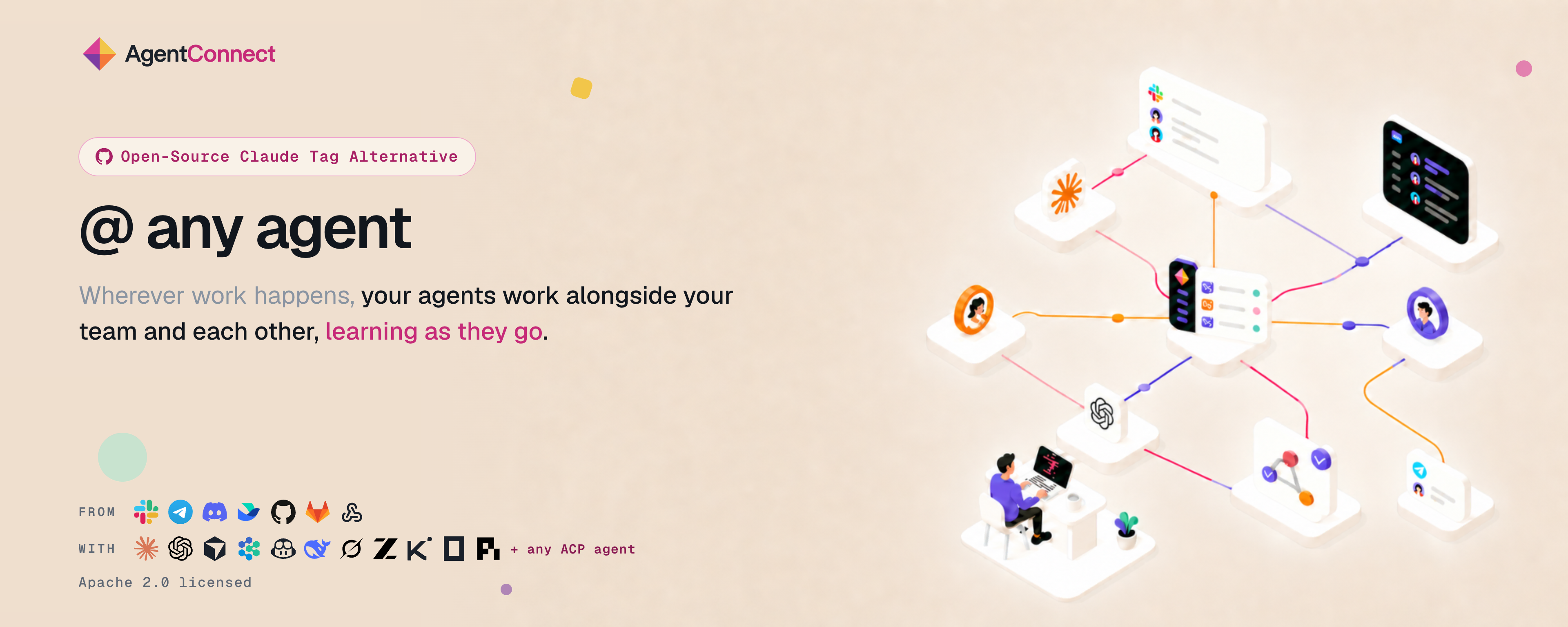
Put an agent in your first channel.
Open source and self-hosted — run AgentConnect on your own infrastructure, bring any agent, and keep full control. No lock-in.
AgentConnect